After having a brief insight into the antic architecture of the region, now it’s time to cast an eye over the next chapter, even more fascinating than the first one: the Middle Ages. Undoubtedly, this period was the most prolific for the Middle East, as the oriental style in architecture and art was obviously contrasting the European architecture from that time. Encompassing a wide range of both secular and religious styles, architecture gave life to spectacular constructions, the most popular being the Mosque, the Tomb, the Palace and the Fort. Ready for a new cultural expedition? The Islamic Architecture will reveal its mysteries in today’s article!

Specifically recognizable Islamic architectural style emerged soon after Muhammad’s time, adapting the former Sassanid and Byzantine models to the new concepts inspired by Islam. First appearing in 691, when the Dome of the Rock was built, this particular style evolved constantly up to the 17th century with the Taj Mahal.
Islamic architecture may be identified with the following design elements:
-
- Minarets or towers ( originally used as torch-lit watchtowers). The minaret of the Great Mosque of Kairouan in Tunisia is thought to be the oldest surviving minaret in the world.
- A four-iwan plan, with three subordinate halls and the principal one that faces toward Mecca
- Mihrab or prayer nicheon, an inside wall indicating the direction to Mecca, was introduced by the Umayyads.
- Domes and Cupolas.
- Pishtaq is a Persian term for a portal projecting from the facade of a building, decorated with calligraphy bands, glazed tilework, and geometric designs.
- Iwan is a rectangular hall or space, usually vaulted, walled on three sides, with one end entirely open.
- The use of Islamic geometric patterns and foliage based arabesques.
- The use of mocárabe and muqarnas, a unique Arabic/Islamic space-enclosing system, for the decoration of domes, minarets and portals, as used at the Alhambra. The models resemble stalactites.
- The use of decorative Islamic calligraphy instead of pictures ( which werem forbidden in mosque architecture, even if in secular architecture, human and animal representation was indeed present.)Calligraphy for the Muslim is a visible expression of spiritual concepts.
- The traditional Islamic courtyard, a sehan is in within almost every mosque in Islamic architecture. The courtyards are open to the sky and surrounded on all sides by structures with halls and rooms, and often a shaded semi-open arcade. Sehans usually feature a centrally positioned ritual cleansing pool under an open domed pavilion called a howz. A mosque courtyard is used for performing ablutions, and a ‘patio’ for rest or gathering.
- Central fountains used for ritual purification (once used as a wudu area for Muslims).
- The use of bright color, if the style is Persian or Indian (Mughal); paler sandstone and grey stones are preferred among Arab buildings.
- Focus both on the interior space of a building and the exterior.
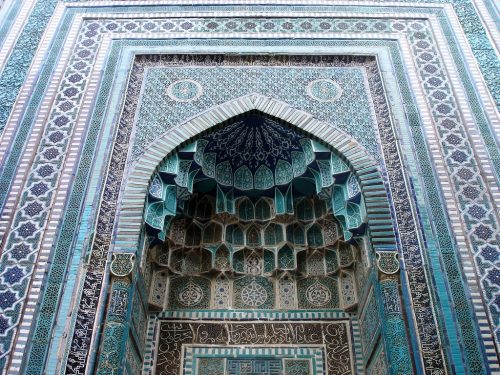
Pishtaq at Shah-i-Zinda – Samarkand
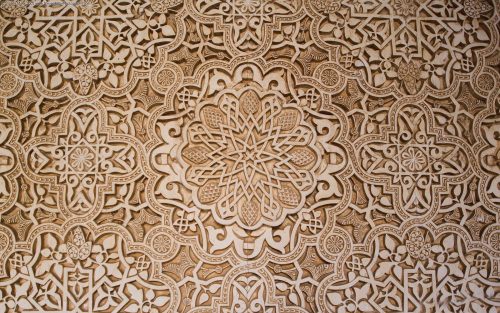
Arabesque
The main motifs encountered in Islamic Architecture are: ordered repetition, radiating structures, rhythmic, metric patterns, as well as columns, piers and arches. The fractal geometry is a key utility when it comes to decorations.
Many forms of Islamic architecture have evolved in different regions of the Islamic world. Arab-plan or hypostyle mosques are the earliest type of mosques, pioneered under the Umayyad Dynasty. These mosques are square or rectangular in plan with an enclosed courtyard and a covered prayer hall. Arab-plan mosques were constructed mostly under the Umayyad and Abbasid dynasties. The Ottomans introduced central dome mosques in the 15th century and have a large dome centered over the prayer hall. This style was heavily influenced by the Byzantine religious architecture with its use of large central domes.
The Umayyads introduced a transept that divided the prayer room along its shorter axis. They also added the mihrab to mosque design. The mosque in Medina built by al-Walid I had the first mihrab, a niche on the qibla wall, which seems to have represented the place where the Prophet stood when leading prayer. This almost immediately became a standard feature of all mosques.

The Dome of the Rock, built by Qubbat-al-Sakhrah during 685-691, is considered to be the first construction representing the Islamic style. Still influenced by the byzantine style, (particularly by San Vitale Cathedral from Ravenna), the ortogonal construction has a an imposing golden dome protecting the holy stone beneath. According to some Islamic scholars, the rock is the spot from which Muhammad ascended to Heaven accompanied by the angel Gabriel.


The Great Mosque of Kairouan (in Tunisia), considered as the ancestor of all the mosques in the western Islamic world, is one of the best preserved and most significant examples of early great mosques. Founded in 670 AD, it dates in its present form largely from the Aghlabid period (9th century).
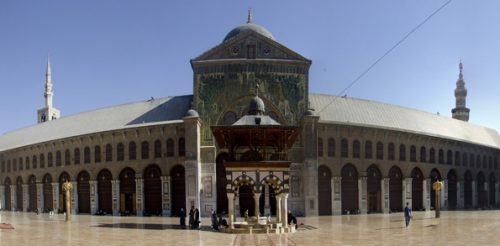
The Great Mosque of Damascus (709-715)

The Abbasid dynasty (750 – 1258) witnessed the movement of the capital from Damascus to Baghdad, and then from Baghdad to Samarra. The shift to Baghdad influenced politics, culture, and art. The Great Mosque of Samarra built by al-Mutawakkil was 256 by 139 metres. A flat wooden roof was supported by columns. The mosque was decorated with marble panels and glass mosaics. The prayer hall of the Abu Dulaf mosque at Samarra had arcades on rectangular brick piers running at right angles to the qibla wall. Both of the Samarra mosques have spiral minarets, the only examples in Iraq.
The Great Mosque of Samarra in Iraq, completed in 847 AD, combined the hypostyle architecture of rows of columns supporting a flat base above which a huge spiraling minaret was constructed.
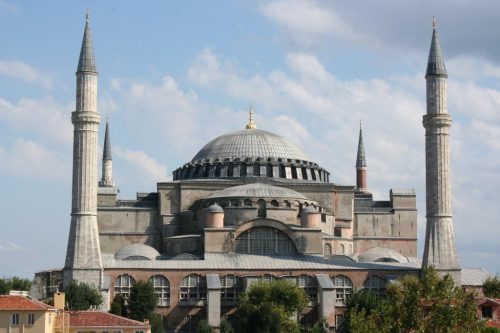
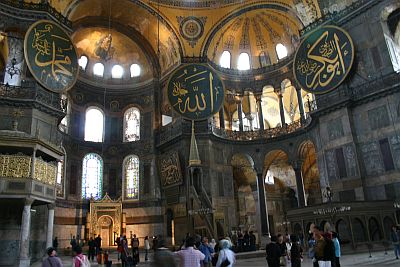
The Hagia Sophia in Istanbul also influenced Islamic architecture. When the Ottomans captured the city from the Byzantines, they converted the basilica to a mosque and incorporated Byzantine architectural elements into their own work (e.g. domes). The Hagia Sophia also served as a model for many Ottoman mosques such as the Shehzade Mosque, the Suleiman Mosque, and the Rüstem Pasha Mosque.
References:
Arhitectura – evolutie, stiluri, personalitati Editura Litera 2010http://en.wikipedia.org/wiki/Dome_of_the_Rock
http://en.wikipedia.org/wiki/Islamic_architecture
http://en.wikipedia.org/wiki/Mosque_of_Uqba
http://en.wikipedia.org/wiki/Arabesque_(Islamic_art)
http://en.wikipedia.org/wiki/Moc%C3%A1rabe
http://en.wikipedia.org/wiki/Muqarnas